Hi Chun, Arik, all,
Thanks for the work on this and the nice recap of the ongoing discussions.
On the discussion about CID 4139:
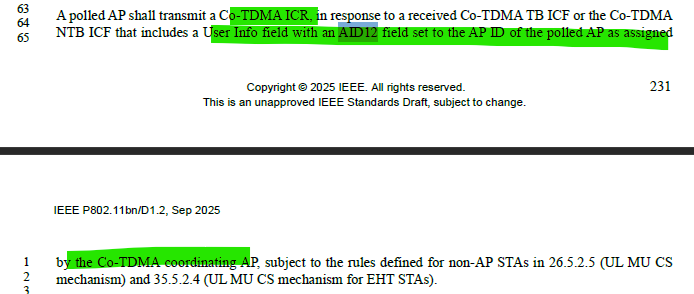
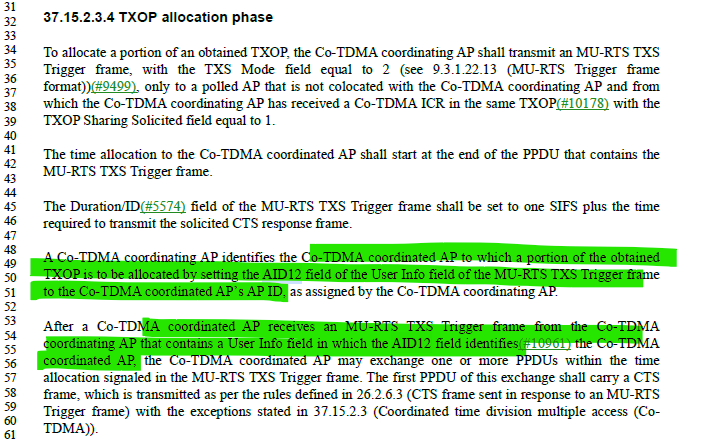
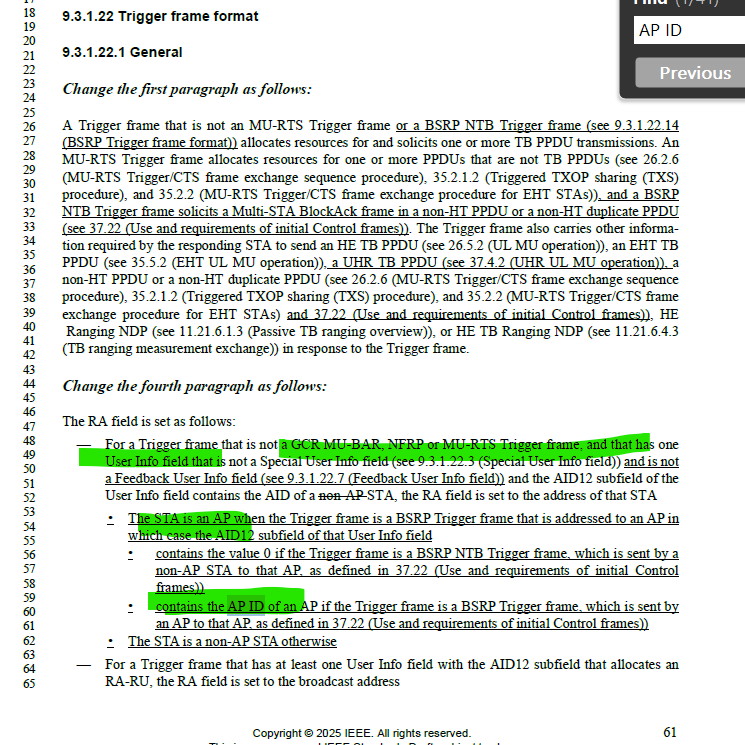
I have a preference for Option 2 (use AID field) as implemented in 25/1875r3. The reason is that at this time, this resolution is complete, while Option 1 implemented
in 25/1875r5 (uses AP ID field) in incomplete. In order to make Option 1 a viable/complete solution there is a need to go through spec and allow inclusion of the newly defined ‘AP ID field’ in many places where the AID field can currently be included, see
the snippets below providing some example of the parts that are assuming reuse of AID field, and would need change in order to pursue Option 1.
In general, it seems that we are departing from the assumption of reusing the AID field, which would entail a relevant workload.
Best,
Giovanni
Co-TDMA (37.15.2.3.3)

From: Arik Klein <0000177967a59511-dmarc-request@xxxxxxxxxxxxxxxxx>
Sent: Monday, December 15, 2025 9:05 AM
To: STDS-802-11-TGBN@xxxxxxxxxxxxxxxxx
Subject: Re: [STDS-802-11-TGBN] Initiate the discussion of AP ID assignment
WARNING:
This email originated from outside of Qualcomm. Please be wary of any links or attachments, and do not enable macros.
Hi Chun,
Thanks for your work on the AP ID Assignment
Regarding CID 7893:
-
Can you please clarify what is the problem with the comment or with the proposed solution? It is not clear what is the problem/concern members have for this CID.
-
Basically, the comment tries to address the case where two or more APs affiliated with an AP MLD are members of MBSSID set (each BSSID on the link it is operating). In this case, the implication on the values that can be assigned for AP ID values (as well as
for AID values) corresponds to the MBSSID set with the larger size (i.e. includes more BSSIDs in the MBSSID set).
Regarding CID 4139:
I’m in favor of option #1.
My concerns regarding option #2 (which “utilizes” the AID field for AP ID value assignment) are:
-
The AID field has a limited range for values that can be assigned for non-AP STAs due to several constraints in AP-non-AP STA communication. However, not all the constraints are applicable in case of AP to AP communication (as in case of MAPC operation). A
good example for that is the newly restriction for UHR STA: “A UHR AP does not assign AID values of 56 to 63 to any non-AP STA or any non-AP MLD “ (see 802.11bn D1.2) – obviously, this limitation is not applicable for AP-AP communication, so it can be assigned
for an AP for the purpose of ICF/ICR frame exchange during a TXOP obtained by the coordinating AP.
-
As its name implies, the Association ID field is used in case there is association relationship between the Assigning entity and the assigned entity. This is not relevant for AP to AP communication. Thus, a separate field for AP ID value is more appropriate
direction (rather than use a confusing field name with many notes to explain your real intention).
Regards,
Arik
From: Sanket Kalamkar <000033b8f79f2eb4-dmarc-request@xxxxxxxxxxxxxxxxx>
Sent: יום ב 15 דצמבר 2025 17:38
To: STDS-802-11-TGBN@xxxxxxxxxxxxxxxxx
Subject: Re: [STDS-802-11-TGBN] Initiate the discussion of AP ID assignment
Hi Chun,
Thanks for your work on this CR document.
My comment is straightforward: the sentence seems too general for the AP ID assignment subclause. It would be better placed in a subclause on general behavior, and a new sentence
could be added to the AP ID assignment subclause that specifically addresses the rules for AP ID assignment.
"A value that is currently assigned as an AID, AP ID or RSID to a STA shall not be assigned
by the AP or by its affiliated AP MLD to any other STA"
Best,
Sanket
From: huang.chun2@xxxxxxxxxx <huang.chun2@xxxxxxxxxx>
Sent: Monday, December 1, 2025 11:40 PM
To: stds-802-11-tgbn@xxxxxxxxxxxxxxxxx <stds-802-11-tgbn@xxxxxxxxxxxxxxxxx>;
arik.klein@xxxxxxxxxx <arik.klein@xxxxxxxxxx>; Giovanni Chisci <gchisci@xxxxxxxxxxxxxxxx>;
ming.gan@xxxxxxxxxx <ming.gan@xxxxxxxxxx>; Abhishek Patil <appatil@xxxxxxxxxxxxxxxx>;
binitag@xxxxxxxxx <binitag@xxxxxxxxx>;
brianh@xxxxxxxxx <brianh@xxxxxxxxx>;
xiangxin.gu@xxxxxxxxxx <xiangxin.gu@xxxxxxxxxx>;
luochaoming@xxxxxxxx <luochaoming@xxxxxxxx>; Sanket Kalamkar <sankal@xxxxxxxxxxxxxxxx>;
liwen.chu@xxxxxxx <liwen.chu@xxxxxxx>
Cc: yang.zhijie@xxxxxxxxxx <yang.zhijie@xxxxxxxxxx>
Subject: [STDS-802-11-TGBN] Initiate the discussion of AP ID assignment
WARNING: This email originated from outside of Qualcomm. Please
be wary of any links or attachments, and do not enable macros.
Hi All
(Sorry for the mistake in the subject line of my last email.)
The document 25/1875r5 was presented in the second conference call on December 1st. There are several follow-up
concerns regarding its content. If you have any further suggestions, please reply to this email.
1.CID 4139(@Abhi, @Arik, @Brian,@Giovanni);
We currently have two versions on this point, both of which seem reasonable. We would like to collect feedback
on this part in order to reach a consensus.
option 1: decoupling AP ID field and AID field. (can refer to 25/1875r5)
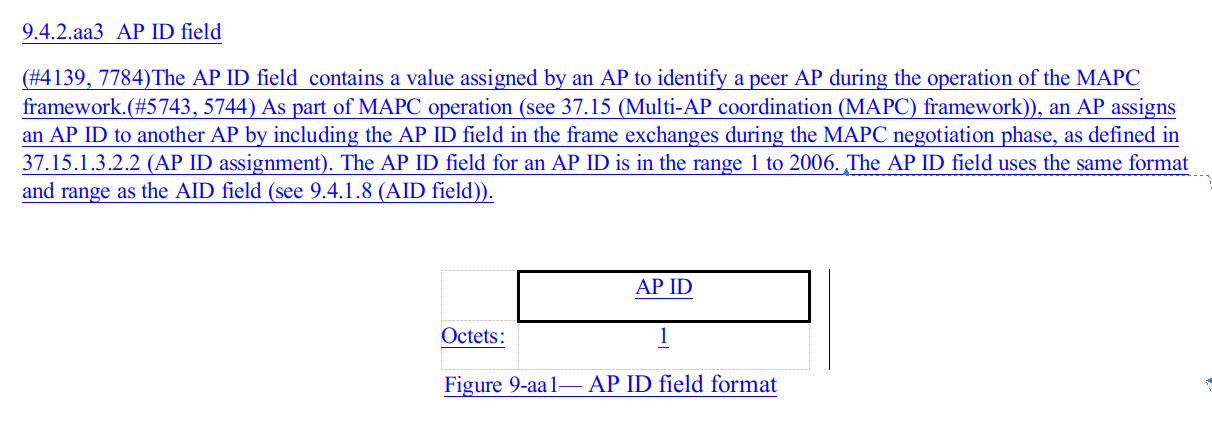
option 2: using the AID field to carry AP ID value. (can refer to 25/1875r3),
and clarifying "The AID field is optionally included in the MAPC Common Info field of a MAPC element (see (#Ed)Figure 9-aa12(MAPC Common Info field format)) as defined in 9.4.1.8 (AID field)."
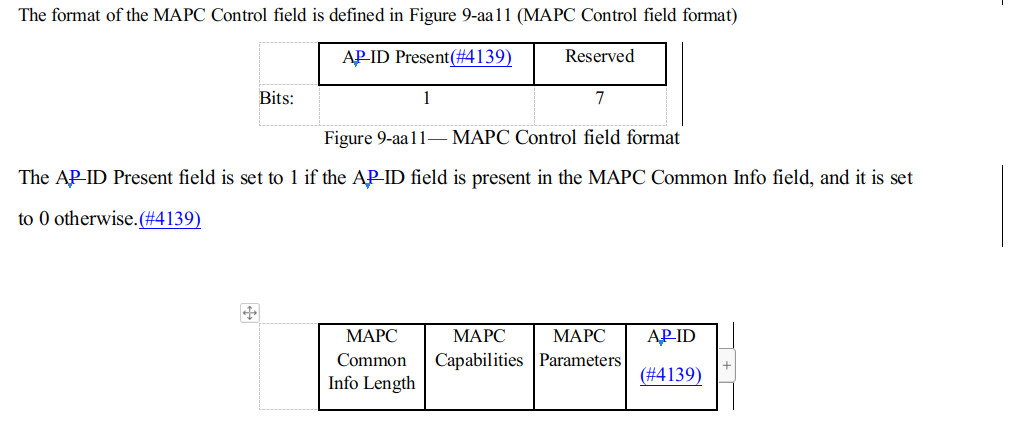
2.According to the decription of “Upon a successful transmission or reception” (@Giovanni, @Brian, @Chaoming Luo);
This kind of description is also used in the baseline, See following
—— “Upon transmission or reception of an FST Teardown frame, the initiator and responder move to the Initial state (11.31.3 (FST setup protocol)).”
——“When a TWT Teardown frame is successfully transmitted or received, the TWT agreement corresponding to the TWT Flow Identifier field, TWT
requesting STA MAC address and TWT responding STA MAC address of the TWT Teardown frame shall be deleted.”
For your consideration, I don’s see any ambiguities for the following three cases, it can be more accurate for
Requesting AP to know when the AP ID becomes valid or shall be released.
-
(#10837)Upon a successful transmission or receptionof the MAPC negotiation response that contains an AP ID field, the assignment of AP ID values included
in the MAPC Negotiation Response frame and in the corresponding MAPC Negotiation Request frame is established.
-
If (#4151,10835) the MAPC responding AP rejects all requests in a MAPC Negotiation Request frame to establish new agreements and there are no previously existing agreements, then (#4152, 10836,
4276) when the MAPC Negotiation Response frame is successfully transmitted or received, the AP ID assignment from the MAPC requesting AP is deleted, and the MAPC responding AP does not assign an AP ID in the MAPC Negotiation
Response frame.
-
(#4277, 4276, 5824)When a MAPC requesting AP tears down all MAPC agreements among the Co-BF, Co-SR, and Co-TDMA MAPC schemes (#7898) with a MAPC responding AP, the mutually assigned AP IDs shall
be released and their values can be reassigned upon a future successful transmission or reception of the MAPC negotiation response frame.
3.AP ID values and AID values(@Sanket)
In the baseline, AP ID values and AID values share the same value pool, so the following sentences can be more
accurate instead of referring just to the AP ID, because if a value has been used as an AP ID, it cannot be used as an AID value. This part can also be reflected in Note 1.
A value that is currently assigned as an AID, AP ID or RSID to a STA shall not be assigned by the AP or by its affiliated AP MLD to any other STA.
4.consider void /deleted / fails (@Xiangxin, @Giovanni, @Brian)
The word “fails” appears to be more accurate.
If (#4151) the MAPC responding AP rejects all requests in a MAPC Negotiation Request frame to establish new agreements and there are no previously
existing agreements, then when the MAPC Negotiation Response frame is successfully transmitted or received, the AP ID assignment from the MAPC requesting AP
fails, and the MAPC responding AP does not assign an AP ID in the MAPC Negotiation Response frame.(#4152, 10836, 10835, 4276, 10837)
5.CID 7893 (@Liwen, @Ming Gan, @Arik)
(#7893)If the AP belongs to a multiple BSSID set, the AP ID value shall be greater than 2n where n is the value carried in the MaxBSSID
Indicator (n) field of the Multiple BSSID element sent by the transmitted BSSID of the AP’s multiple BSSID set.
If an AP is affiliated with an AP MLD that has at least two affiliated APs where each of them is a member of a multiple BSSID set, the AP ID value assigned by any AP affiliated with that AP MLD shall be greater than 2m,
where m is the maximum value indicated by the MaxBSSID Indicator field in each of the Multiple BSSID elements corresponding to each of the APs affiliated with the AP MLD.
Best Regards,
Chun Huang
To unsubscribe from the STDS-802-11-TGBN list, click the following link:
https://listserv.ieee.org/cgi-bin/wa?SUBED1=STDS-802-11-TGBN&A=1
To unsubscribe from the STDS-802-11-TGBN list, click the following link:
https://listserv.ieee.org/cgi-bin/wa?SUBED1=STDS-802-11-TGBN&A=1
To unsubscribe from the STDS-802-11-TGBN list, click the following link: https://listserv.ieee.org/cgi-bin/wa?SUBED1=STDS-802-11-TGBN&A=1