Dear Morteza, Gaurang, Sindhu, Matt, and all,
I would like to continue our discussion regarding CR 2008 (attached for reference).
Many thanks for your comments and suggestions, which have been helpful in improving the proposed text.
If I recall correctly, a few questions were raised during our discussion, and I would like to share some additional thoughts.
- Why can't the AP simply refrain from initiating DSO exchanges?
That is certainly possible from an implementation perspective. However, it does not resolve the normative question of whether DSO mode should remain enabled when its assigned
subband is no longer usable. The current specification already prohibits the initial assignment of an entirely punctured DSO subband, but it does not explicitly maintain the same validity requirement after the subband has been assigned and the applicable puncturing
bitmap changes. Our proposal aims to address this inconsistency and define an unambiguous behavior following such an update.
- Why does the AP need to disable DSO?
The existing normative text already requires DSO to be disabled when a bandwidth change causes the assigned DSO subband to fall outside the applicable BSS or DBE bandwidth.
Our proposal simply extends the same principle to another case where the assigned DSO subband becomes unusable, namely when all its constituent 20 MHz subchannels become punctured.
In other words, remaining within the applicable bandwidth is a necessary but not sufficient condition for the assigned DSO subband to remain usable. While keeping DSO enabled
without initiating DSO exchanges could be an alternative, this would require defining the conditions under which DSO operation is suspended and subsequently resumed. We believe that reusing the existing disablement behavior provides a simpler and more consistent
normative solution.
- Why not reassign the STA to another DSO subband instead of disabling DSO?
Reassignment is certainly possible, and the existing DSO framework already provides mechanisms for it. However, reassignment is not guaranteed to succeed, and another valid
DSO subband might not be available. Furthermore, the non-AP STA may reject a proposed reassignment. Our proposal provides a deterministic outcome when the existing assignment becomes invalid, without depending on the availability or successful negotiation
of another DSO subband.
Overall, the intention is not to introduce a new restriction on DSO operation, but rather to ensure that the existing DSO subband validity requirements are applied consistently, both at initial assignment
and following subsequent operating-parameter updates.
Please find here the attached the proposed text:
|
|
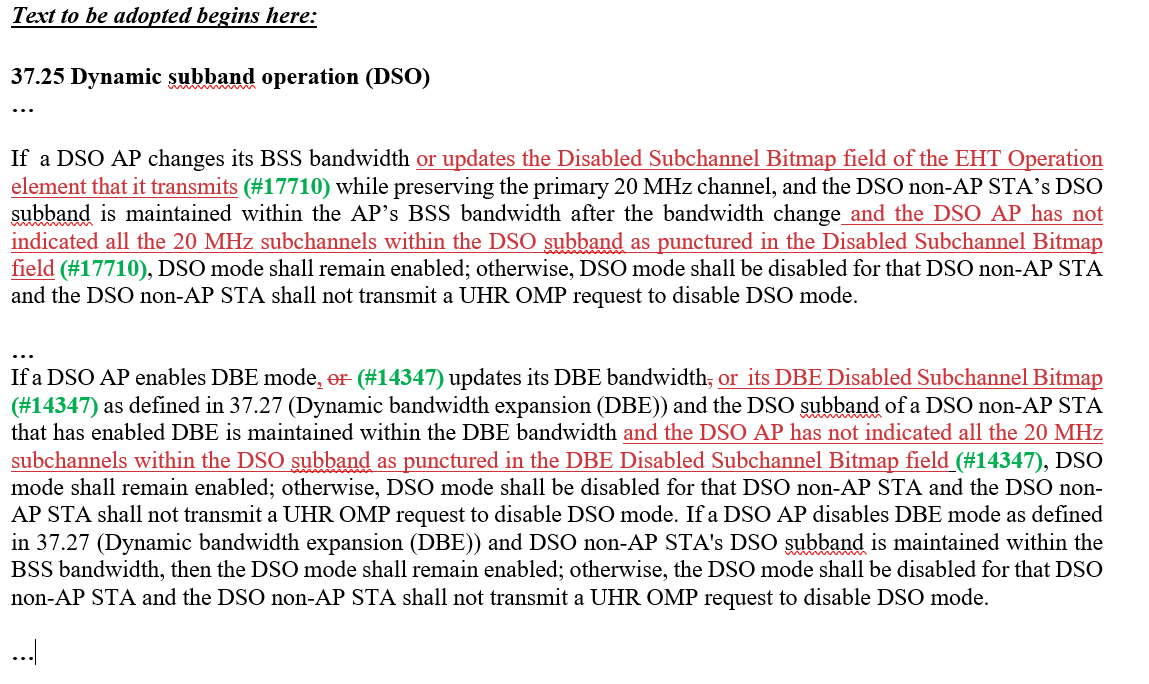
Please let me know if you have any further comments/questions
Many thanks,
- Salvatore (Nokia)
To unsubscribe from the STDS-802-11-TGBN list, click the following link: https://listserv.ieee.org/cgi-bin/wa?SUBED1=STDS-802-11-TGBN&A=1